Constructing a Champion, Part 1: Building a Roster
Taking a closer look at how the Titans roster stacks up against the past 10 Super Bowl champions.

I’ve spent a little time this winter mulling over the state of this Titans rebuild and where they’re at in the process. When Mike Borgonzi was hired to be this team’s GM, I thought it would it take him about four player acquisition cycles to really flesh out this roster. That’s how rough the situation was.
But, what I’ve come around on is Ran Carthon’s 2024 class being the unofficial restart to this rebuild - that class had building blocks in Cedric Gray and JC Latham, potential solid contributors in Jaylen Harrell and James Williams, and it even netted an edge rusher in Jermaine Johnson II (by way of T’Vondre Sweat). Getting the franchise quarterback, some young defensive talent, and a few developing offensive weapons for Cam Ward in 2025, and it’s “so far, so good” in this rebuild. I wanted to see if I could put together some actual research to gauge whether my gut feeling is right or not on this thing.
So, I decided to look back at the last 10 Super Bowl champions and dig up some percentages on how those rosters were constructed and how the 2025 Titans stacked up. This isn’t divided by starters - it’s a raw look at players who were on a team’s active roster at any point during the season and how that player was acquired. With free agency approaching, it’s a good spot to establish a baseline of where the Titans are at before another cycle begins.
Results
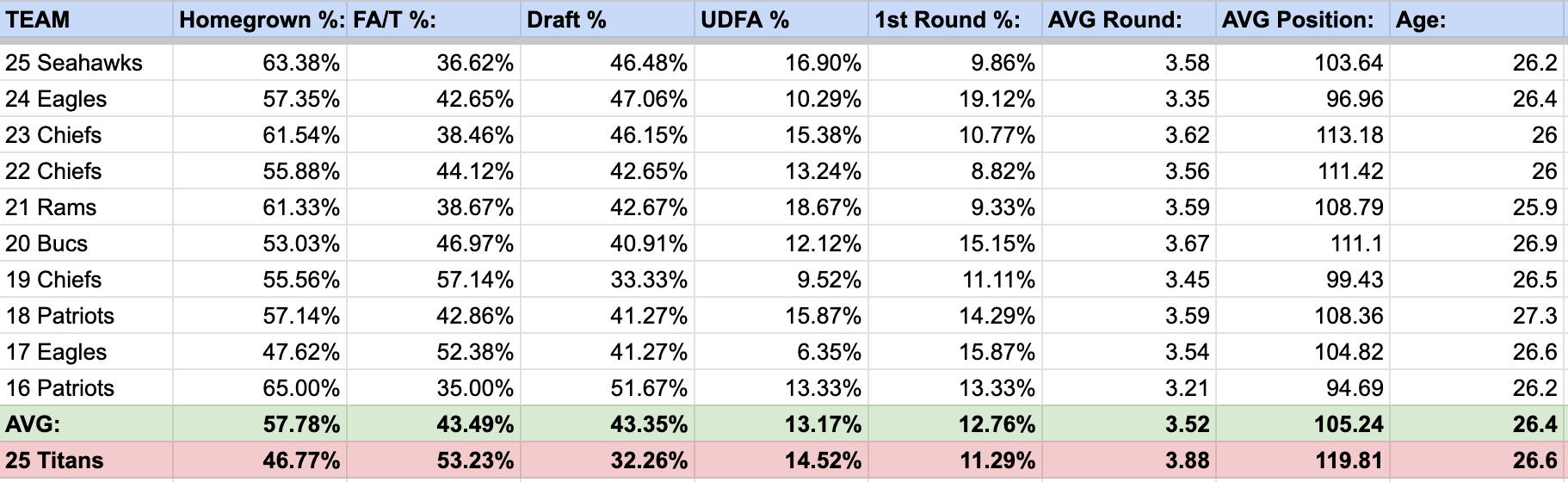
My biggest takeaway from this exercise is that the last 10 Super Bowl champions have a rate of homegrown talent at 57.78% - these are players that the team drafted or brought in as a UDFA. It’s “homegrown” in the literal sense - these players haven’t known another NFL program.
Just 43.49% of players were free agent or trade acquisitions.
Only 13.17% of these rosters were UDFA players - this was captured to measure talent, so this number includes UDFA players that were brought into the league by their team or were veteran players signed from another team during free agency.
12.76% of the draft picks on the Super Bowl champion rosters were first round picks.
The draft picks of the Super Bowl champions were selected at an average spot of 105.24 in the NFL Draft.
How the Titans stack up
You might have guessed it - simply put, the Titans have more mercenaries and less homegrown talent. 53.23% of the 2025 Titans roster was a free agent or trade acquisition. Only 46.77% of the 2025 Titans roster would be deemed homegrown.
The 2025 Titans roster was comprised of more UDFA caliber players than the Super Bowl champion rosters - that mark for the Titans sits at 14.52%.
The 2025 Titans have considerably less talent than the Super Bowl champions. Capturing this by counting the number of first round picks on a roster isn’t a perfect formula, but typically, the more talented guys go earlier in the draft. So, I considered that in this exercise. The champs have a higher percentage of former first round picks, and the average draft pick from a Super Bowl champ came 14.57 spots higher in the draft than the average draft pick from the Titans.
Correcting Course
So, yeah - it went about as I expected it to. The Titans are still early in the process of establishing their own homegrown process and culture. That is the number that needs improving the most. But, the talent aspect of this was a bit surprising to me, so maybe it’s worth coveting a bit more. In free agency, don’t just fill holes, but take chances on talent a bit too.
The encouraging thing about the current state of the Titans roster is that one more good draft class and some prudence in free agency could get this roster closer to the metrics that define these past 10 Super Bowl champions. They have nine draft picks this year - assuming all nine make the team this year, we take five UDFAs away, and take four FA/T players away, using the 2025 roster for this thought exercise, that alone gets the homegrown percentage from 46.77% to 53.23%. Another cycle like that in 2027 and the Titans would line up pretty well with the makeup of a Super Bowl champion. Stay the course - they’re actually on track so far.
In Part 2, we’ll look at common threads among the Super Bowl champions and how they use the salary cap if I ever actually take a break from draft stuff long enough to do that research. Oh, and if you want the raw data, here’s the dashboard from my spreadsheet: